
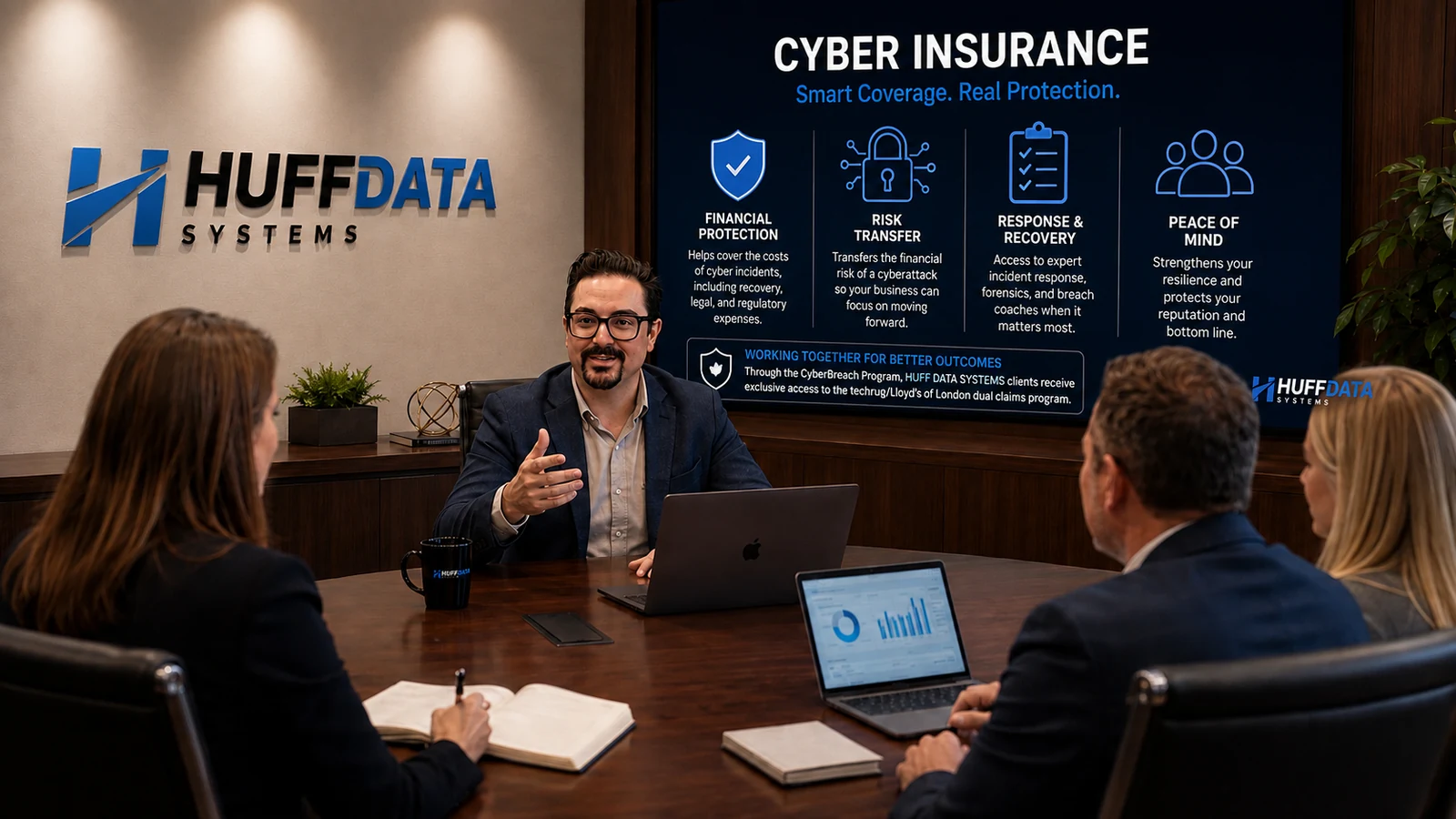
Cyber Insurance + Cybersecurity Alignment

Cyber Liability Insurance That Works With Your Security Program

Cyber insurance should be more than a renewal questionnaire. HUFF DATA SYSTEMS helps clients align cybersecurity controls, documentation, incident response and available cyber liability coverage so the policy and the technology protecting the business are working toward the same goal.

HUFF DATA SYSTEMS cyber insurance, risk transfer, incident response and recovery planning
The problem businesses face

Having a policy is not the same as being prepared for a claim.

Cyber liability insurance can help transfer part of the financial risk created by ransomware, data breaches, business interruption and other covered cyber events. But coverage depends on the actual policy, exclusions, representations made during underwriting and the circumstances of a loss.

That makes the relationship between your insurance application and your real security environment important. If a renewal application says a control is deployed, the business should be able to demonstrate that the control is actually implemented and maintained.

Renewal readiness

Can you prove the controls you are attesting to?

  • Multi-factor authentication and identity controls
  • Endpoint protection and security monitoring
  • Backup, recovery and restore testing
  • Patch and vulnerability management
  • Administrative access and least privilege
  • Incident response planning and documentation
A different model for HUFF DATA SYSTEMS clients

Keep your security provider and your security stack.

Through the CyberBreach Program, qualifying HUFF DATA SYSTEMS clients can review a cyber liability insurance option designed around the MSP relationship. Eligibility, pricing, underwriting and coverage remain subject to the applicable insurer and policy terms.

01

Dual Claims Coverage

The program is structured so the client’s cyber liability coverage and the IT service provider’s coverage can work in tandem within the program rather than beginning with two unrelated insurers protecting opposing interests.

The objective is to reduce potential coverage friction and better align the parties involved when a covered cyber event occurs.

02

Incident Response Alignment

Where the IT service provider holds the applicable DFIR accreditation and is accepted as an endorsed panel vendor under the policy, the existing provider can participate within the defined incident-response framework for events within its approved scope.

That can preserve valuable knowledge of the environment when response speed and coordination matter.

03

Your Existing Security Program

The insurance option is designed for clients who remain active with their MSP and continue using the qualifying security stack rather than requiring the client to replace its established security provider with services sold through an insurance channel.

That keeps technology strategy, security operations and insurance preparation more closely aligned.

Official CyberBreach Program information

Explore the HUFF DATA SYSTEMS CyberBreach Program

Review program details directly from techrug, including dual claims coverage, DFIR response, potential premium savings, the claims-response model, and the questionnaire used to request an insurance indication.

View CyberBreach Program Details
Why alignment matters

Your cyber policy and your cybersecurity controls should tell the same story.

HUFF DATA SYSTEMS can help review the technical questions commonly encountered during cyber insurance applications and renewals. Our role is not to interpret insurance contracts or guarantee coverage. Our role is to make sure the technology statements about the environment can be answered accurately and supported by evidence.

Before renewalReview technical controls and identify gaps before the application is submitted.
During underwritingProvide accurate technical information about the controls HUFF DATA SYSTEMS manages.
After bindingContinue maintaining the security controls the business represented to the insurer.
During an incidentFollow the policy’s required notification and response procedures while coordinating technical response.
One coordinated risk strategy
Cyber Liability InsuranceFinancial risk transfer for covered events
Incident ResponseDefined escalation, evidence preservation and recovery
Managed CybersecurityIdentity, endpoints, monitoring, access and resilience
Business TechnologyThe systems, people and data the business depends on
CIS Controls alignment

Build toward insurability with a stronger security baseline.

HUFF DATA SYSTEMS uses the CIS Controls as an organizing framework for cybersecurity improvement. CIS Implementation Group 2 is a practical target for many established businesses with meaningful operational and data risk, while IG3 adds safeguards appropriate for organizations facing higher-value or more sophisticated threats.

CIS IG2

Builds on foundational cyber hygiene with broader controls for identity, vulnerability management, data protection, logging, recovery, security awareness and incident response.

CIS IG3

Adds safeguards for organizations with greater risk exposure, more sensitive information, regulatory obligations or a need to withstand more sophisticated attacks.

CIS alignment can strengthen a security program, but it does not by itself guarantee eligibility, pricing, claim payment or compliance with a particular insurance policy.

What cyber insurance can help protect

A serious cyber incident can create costs far beyond replacing a computer.

Depending on the policy and event, cyber liability insurance may provide coverage for categories such as incident response, digital forensics, business interruption, data recovery, notification, legal expenses, privacy liability and certain cybercrime losses. Actual coverage varies by policy.

Business interruptionLost operating time and income while systems are unavailable.
Forensics & responseSpecialized investigation, containment and recovery services.
Legal & notificationPotential legal counsel, regulatory response and affected-party notification.
Data recoveryCosts associated with restoring systems and information after a covered event.
LiabilityPotential third-party claims arising from privacy or security incidents.
Reputation & recoveryResources that may help the organization manage the aftermath of a major event.
Questions to ask before renewal

Do not wait until the application is due to discover a security gap.

01

Are the security controls listed on the application actually deployed everywhere the answer implies?

02

Can the business produce evidence showing those controls were active before an incident?

03

Are backups isolated, monitored and regularly tested for restoration?

04

Does the incident response plan identify who contacts the insurer, legal counsel and technical responders?

05

Does the policy require use of specific incident-response, legal or forensic vendors?

06

Do management, the insurance advisor and the IT/security provider agree on how the environment is represented?

For current and prospective HUFF DATA SYSTEMS clients

Review your cyber insurance strategy before renewal.

We can review your current cybersecurity posture, discuss the CyberBreach Program option, and help identify technical gaps that should be addressed before you complete your next cyber liability application.

Important: HUFF DATA SYSTEMS is an information technology and cybersecurity provider, not an insurance carrier or law firm. Insurance availability, discounts, eligibility, premiums, policy terms, exclusions and claim decisions are determined by the applicable licensed insurance professionals, carrier and policy. Nothing on this page is a guarantee that a claim will be covered or paid. Review actual policy language with your licensed insurance advisor.